Why can an airplane, a massive machine weighing hundreds of tons and made of metal, fly in the sky? In this article, we will use the largest passenger aircraft in history, the Airbus A380, as an example to start a crash course about airplanes. 🙂
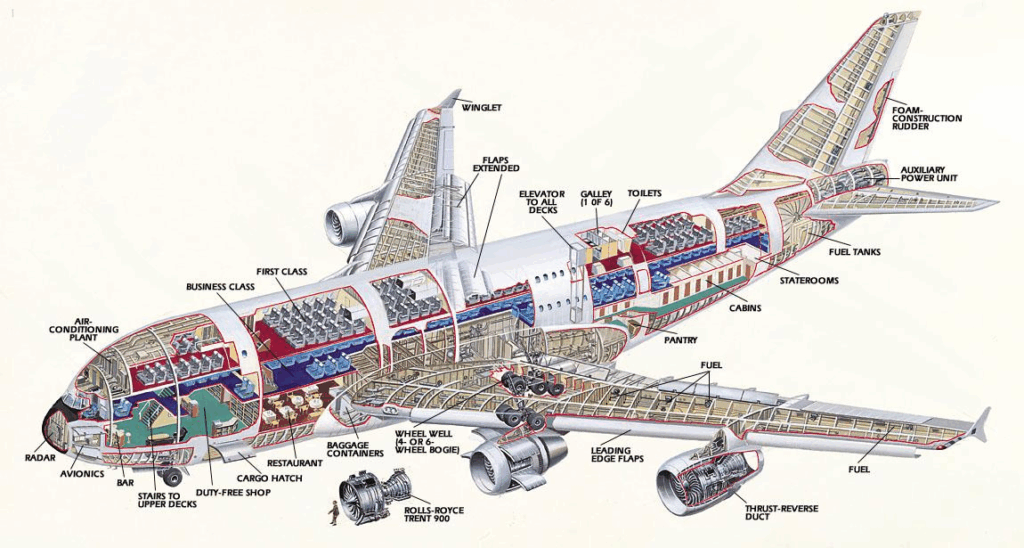
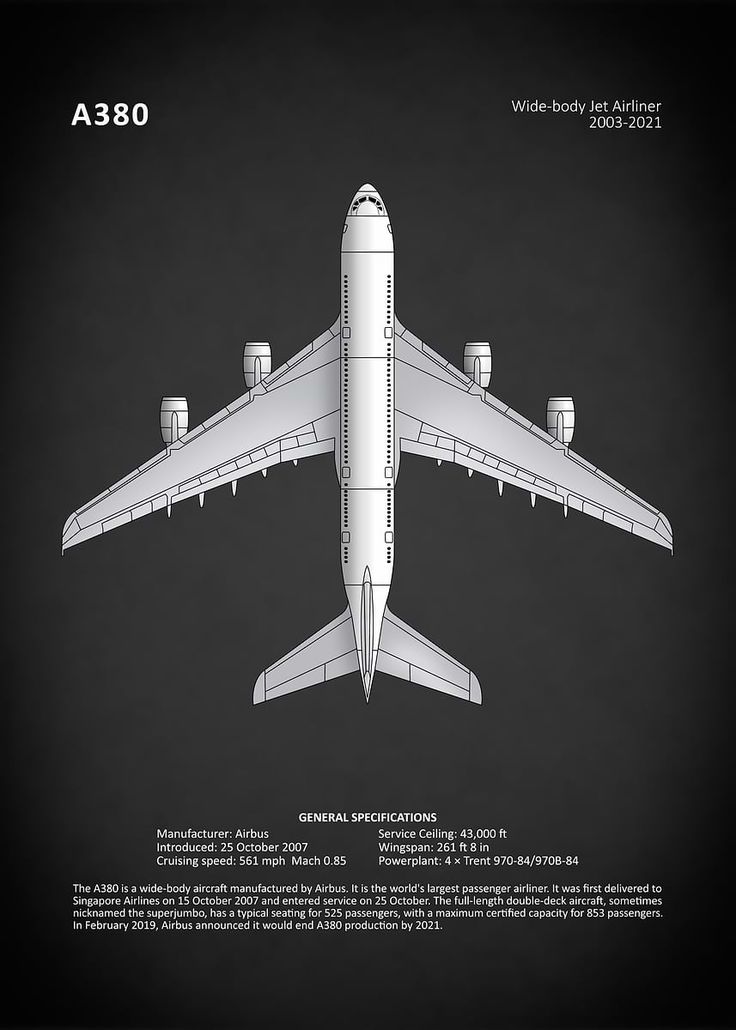
The Airbus A380 has an overall length of 72.72 meters and a wingspan of 79.75 meters. To help you imagine its size in everyday terms, a typical soccer field is about 105 meters long and 68 meters wide. Also, from the ground to the highest point of the vertical tail fin, the height is 24.09 meters, roughly equivalent to an eight-story building. Looking at it this way, you can see just how big the airplane really is. In terms of weight, the combined total of the airframe, fuel, passengers, and cargo can reach up to 560 tons.
At the front of the aircraft is the passenger cabin, while the rear section shows the panels that make up the airframe.
The A380’s seating is divided into two levels. On ANA’s A380, the upper deck at the front has eight first-class seats, followed by 56 business class seats, and 73 premium economy seats further back. The main (lower) deck has 383 economy class seats. Compared to previous aircraft, the A380’s cabin is characterized by being exceptionally quiet.
The A380’s wingspan is about 1.5 times larger than that of the Boeing 747, a popular American passenger aircraft affectionately known as the “Jumbo Jet.” Because of this, the A380 is sometimes called the “Super Jumbo.”
When you look at the A380 from the front, compared to the size of the fuselage, you can tell that the main wings are extremely long. This long wing span produces lift, which makes it possible for the A380 to fly.
On the main wings, there are a total of four huge turbofan engines (two on each side). Each engine weighs about 6.5 tons. The reason the wings don’t break is that the area where the wings attach to the fuselage is made of “aluminum alloy,” which is both light and strong.
The A380 underwent about 2,500 hours of test flights, including a “cold weather test” to check engine performance in extremely cold conditions of -30°C, and a “high temperature test” carried out in desert regions. The A380 was completed in 2007, after undergoing these rigorous tests.
When an airplane races down the runway, it takes off and lifts into the sky. While in flight, it skillfully controls its posture and maintains stable flight toward its destination. And then, it smoothly descends from the sky to the ground and comes to a stop. Let’s take a look at the surprising mechanisms behind airplane flight.
Now, let’s see how the A380 actually flies in the sky.
Question: Where is airplane fuel stored?
Fuel is stored inside the wings.
For an airplane to fly, it needs a large amount of fuel. The structure of an airplane’s wing uses internal “spars” (longitudinal beams) and “ribs” (crosswise supports) that are fitted together, and further strengthened with additional thin beams called “stringers.”
The inside of the airplane’s wings is shaped like a row of boxes, and the fuel is stored in these spaces within the wings. In the case of the A380, fuel is stored not only in the main tanks inside the wings, but also in the central tanks and the tanks at the wingtips.
The total fuel capacity is 320,555 liters (about 256,440 kg). At 0.8 kilograms per liter, a detailed calculation results in this amount.
The reason fuel is stored inside the wings can largely be divided into two main points.
The first reason is simply convenience. The fuel tanks are located near the engines, and when the engines draw fuel, it can be delivered in a very short pipeline. For example, if the fuel tanks were placed far away, the fuel would have to be sent through long pipes, and if the pipes broke or connections loosened, all of the fuel could leak out instantly. If that happened, operating the aircraft would become extremely difficult.
The second reason is for balance. While flying, the wings generate lift, and the weight of the fuel stored in the wings balances out the lift and helps to keep the airplane stable. For example, in the case of the A380, the maximum capacity of a single wing tank is about 280 tons. On the other hand, the “center tank” also has fuel. By controlling the fuel in these tanks, only the necessary amount is used for balance, which reduces wasted fuel and makes it possible to use the airplane more efficiently and safely.
Question: What is “Lift,” the Force on the Wings During Takeoff?
The main wings experience an upward force,
while the horizontal stabilizers experience a downward force.
The secret to how airplanes can fly by making use of the flow of air lies in the “wings” that airplanes have.
The wings of an airplane receive wind from the front, and by skillfully controlling the flow of air over them, they are able to generate a “force that lifts the wings up.”
This force, which acts perpendicular to the direction of flight, is called “lift.” Put simply, an airplane uses the property of air (airflow) to generate the force needed to lift its own body.
The main wings of an airplane generate an upward lift. However, that alone isn’t enough to make the airplane take off. In order to take off, it is also necessary to slightly lift the nose of the airplane.
At the moment of takeoff, a strong upward lift is generated at the main wings, while a downward lift is generated at the horizontal stabilizers. This pushes the back of the plane downward, raising the nose of the aircraft. As a result, as the angle of the main wings increases, the lift generated increases even further, allowing the airplane to leave the ground and take off into the sky.
Question: How does the plane handle the sudden gusts?
Stabilized by the vertical stabilizer and horizontal stabilizer.
Once an airplane takes off, it heads toward its destination while controlling its attitude and being steered. Airplanes can quickly return to a steady posture, even when hit by sudden gusts of wind. This is all thanks to the vertical stabilizer and horizontal stabilizer.
For example, if a sudden gust pushes the aircraft’s nose to the left, the airplane will then be hit by wind from the right.
- The airflow angle changes, and the vertical stabilizer catches wind from the right side, producing lift that turns the aircraft back toward the right.
- At the same time, if the fuselage rolls and the nose swings, the horizontal stabilizer also works to stabilize the plane’s movement up and down.
So, thanks to the vertical stabilizer, the nose returns to facing forward, and any shaking left and right is stabilized by the vertical stabilizer, while shaking up and down is stabilized by the horizontal stabilizer.
Question: How to Turn an Airplane’s Nose Left and Right
Move the vertical tail’s “rudder” left and right.
The rudder on the vertical stabilizer and the elevators on the horizontal stabilizer do more than just correct for shaking. The pilot operates the rudder and elevators to change the direction and attitude of the aircraft.
When a pilot wants to change the direction of the aircraft while flying, two main movable parts are used. The rudder controls movement to the left and right (called “yaw”), while the elevators control up and down movement (“pitch”). Controlling these together allows the pilot to change the attitude of the airplane smoothly.
As an example: When turning the nose left or right, the rudder (located on the vertical stabilizer) is mainly used. The ailerons on the wings, which are used for rolling (tilting the wings left and right), can certainly help to change the direction, but it is primarily the action of the rudder that points the nose left or right. For changes in pitch (up and down movement), the elevators on the horizontal stabilizer are used.
In summary, the “rudder” on the vertical stabilizer is primarily responsible for turning the airplane’s nose left and right (“yaw”), and the “elevator” on the horizontal stabilizer is primarily responsible for up and down movement (“pitch”).
The Small Wings That Do Important Work
When an airplane changes direction, the “elevator” on the horizontal stabilizer, the “rudder” on the vertical stabilizer, and the “aileron” on the main wing are used. These three, collectively called “control surfaces,” are essential for flight.
Compared to the size of the main body of the airplane, these control surfaces are very small, but they are able to change the aircraft’s orientation. This is because their locations are far from the aircraft’s center of gravity. The center of gravity of the airplane is located near the center of the fuselage. Because each control surface is positioned far from the center of gravity, even a small control surface can produce a large moment (rotational force) to move the entire aircraft. In this way, even small “working wings” can generate enough force, according to this principle, to move the whole airplane.
Question: How a Landing Airplane Comes to a Stop
Three types of brakes safely stop an airplane.
When the landing gear touches down, the A380 finally experiences the moment of landing.
To safely bring the plane to a stop, airplanes use three kinds of brakes upon landing.
The first is the “spoiler,” a brake located on the wings.
Spoilers are deployed at the moment the tires touch the runway, at the same time as touchdown. When raised, spoilers increase air resistance and quickly reduce speed. At the same time, they decrease lift, allowing the brakes on the tires to work more effectively.
The second brake is the “disk brake” attached to the landing gear.
Disk brakes create friction by pressing disks and wheels together, stopping the rotation of the wheels.
The third brake is “reverse thrust” provided by the turbofan engines.
The turbofan engine blocks the bypass airflow with a door and redirects the exhaust forward, changing the direction of thrust. This reduces the speed of the airplane.
In this way, the landing airplane uses these three types of brakes together to safely come to a stop on the ground.
Landing
When an airplane lands, it follows the guidance of an “Instrument Landing System (ILS).”
The airplane flies above the runway as instructed by the ILS. The ILS is a device that sends radio signals from the airport to airplanes approaching for landing, to guide them safely to the runway.
The ILS system uses three types of radio signals:
- The “localizer,” which tells the aircraft if it is to the left or right of the runway centerline.
- The “glide path,” which gives information on whether the aircraft is above or below the ideal descent angle toward the runway.
- The “marker beacon,” which indicates the distance to the runway threshold.
By referencing these signals, the airplane can approach the runway accurately.
To use an analogy, it’s like riding a bicycle along a painted line—by following the line, you can reach your destination safely.
Normally, the pilot lands the aircraft by referencing ILS information. However, if certain conditions are met, it is possible for the airplane to land completely automatically. For example, the wingspan of the A380 is 79.75 meters. In contrast, the width of a runway is only about 30 to 45 meters, some runways are just 60 meters wide.
This gives you an idea of how important and precise it is for airplanes to line up perfectly with the runway when landing.
Question: What is the difference between runaways for planes and roads for automobiles?
Many layers of foundation structures are built underground.
The runways that airplanes land on are very different from ordinary roads for cars and are given special attention.
For example, in the case of the A380, the maximum takeoff weight reaches 386 tons. Runways must be built so that when an aircraft as heavy as this lands at a speed of about 250 kilometers per hour (the typical landing speed), it does not get damaged in any way.
For this reason, runways are constructed with multiple layers of foundation structures built deep underground, followed by 2–3 meters of thick asphalt on top.
For example, at airports built on reclaimed land, such as Kansai International Airport, the ground beneath the runway is reinforced by carrying out ground improvement work several tens of meters deep to prevent the earth from giving way.
Additionally, runways are paved with grooves so that airplane brakes can grip easily and to prevent slipping when it rains. Various measures like these are taken to ensure the safety and durability of runways.
Lighting the Way for Airplanes with Lights
The lights that assist in guiding aircraft are called “aeronautical lights.”
When you go to an airport or airfield at night, you’ll see areas like runways, taxiways, and aprons lit up, almost like an illuminated display, these are called “airport lights.”
Airport lights serve to inform approaching and departing aircraft of the shape of the runway, approach angles, and other important information.
There are various types of airport lights, each using different colors. For example, the center and ends of the runway mainly use “white,” while the center line of the taxiway is “green” and the edges are “blue.”
At runway ends and places where aircraft must stop, warning lights in “red” are used.
Also, aviation law requires that objects protruding 60 meters or more above the ground or water must have “obstruction lights” installed. The type, location, and number of these lights to be used on buildings, towers, chimneys, and other high structures are all specified depending on the height and width of the object.
Question: How long does it take for the preparation for the next flight?
Preparation for the Next Flight is Finished in 90 Minutes!
Even though the airplane has safely completed its flight, there’s no time to rest. Preparations for the next flight begin immediately.
Generally, for international flights, the turnaround time is about two hours, while for domestic flights, it’s between 45 and 60 minutes before the next departure. In this short period, not only are the cabin cleaned and restocked, but maintenance checks of the aircraft must also be performed. This check is called a “line maintenance” inspection.
In a line maintenance inspection, in addition to checking the appearance of the aircraft with the naked eye, technicians check for things like leaks or whether the tires are worn down. If any problems are found, repairs must be completed before the aircraft can take off again.
To ensure efficient operations, airlines strive to minimize the time the aircraft spends on the ground by monitoring its condition in detail and preparing for necessary maintenance in advance. Technicians use data sent from the aircraft to prepare for any parts needing replacement and get ready so that maintenance can be carried out as quickly as possible and the aircraft can be turned around efficiently.
Side Note 1:
The A380’s “Heart”: The Turbofan Engine!
Its maximum thrust is a massive 34.5 tons!
The enormous power that enables the giant A380 to fly comes from four powerful turbofan engines mounted under its wings.
A turbofan engine generates thrust by taking in a large volume of air, accelerating it inside the engine, and expelling it backward.
The A380 uses either the “Trent 900” or “GP7000” turbofan engines. If you look at the engine from the front, you’ll notice a difference: the Trent 900 rotates clockwise, while the GP7000 rotates counterclockwise.
Side Note 2:
The Structure of a Turbofan Engine
The “bypass flow” generates a large amount of thrust!
A turbofan engine first uses a huge fan to take in a large volume of air (1). The air that is drawn in is split into two flows. The air in the central part is compressed by a compressor and sent into the combustion chamber (2). In the combustion chamber, it is mixed with fuel and ignited (3). The high-temperature, high-pressure gases produced by combustion drive a turbine that turns the compressor and fan, and are then expelled backward as jet exhaust (4).
The other portion of air, which was separated at the start, flows around the outside of the engine core. This airflow is called the “bypass flow.” In turbofan engines with a high bypass ratio, the majority of the air is bypass flow, and this large volume of airflow is what generates much of the thrust.
Since the bypass flow moves at a speed close to that of the surrounding air, it does not produce much acceleration, but its large volume compensates for this. As a result, although the portion that is actually combusted and converted to energy is small, the propulsion efficiency of turbofan engines on airplanes is extremely high. In fact, this also means that fuel consumption can be reduced. In other words, an engine with a high bypass ratio is both powerful and efficient. Additionally, the slower bypass flow helps suppress noise.
Side Note 3:
No Controls? The A380 Cockpit
Control wheels eliminated, adopting side sticks
When flying, things like altitude, speed, aircraft attitude, flight path, and status of various equipment must all be monitored and controlled. In the past, pilots had to scan a multitude of separate instruments, but now all critical information is consolidated and displayed on LCD screens. This system is known as a “glass cockpit.” Thanks to this system, the burden on pilots has been greatly eased.
When we think of piloting an airplane, we often imagine a control yoke shaped like a “Y”. However, in the A380, the traditional control yoke has been eliminated and replaced with “side sticks.”
In the A380, these side sticks are installed next to each pilot’s seat in place of the conventional control yokes. This makes the cockpit more spacious and removes the need for a large control column in front of the pilot, allowing easy access to instruments and the monitor panels. As a result, adjusting the seat up and down or getting in and out of the pilot’s seat is much easier, and even on long-haul flights, pilots can operate more comfortably with less fatigue.
Additionally, the A380 is equipped with various advanced backup systems. For example, it has a multi-display backup system (called a head-up display) so that, even if the main displays fail, pilots can still fly safely. Thanks to these ergonomic advances, pilots can now instantly grasp essential flight information on the display screens in front of them.
Side Note 4:
Techniques to Increase the Strength of the A380’s Fuselage
Eggshell-like curved outer panels support the load
The A380’s fuselage uses a structure called a framework, which is shaped like an eggshell, combined with reinforcing materials running longitudinally called “stringers,” adopting what’s known as a “semi-monocoque structure.” “Monocoque” is a French word that means “egg shell.”
In the semi-monocoque structure, not only the frames but also the curved outer panels, shaped like an eggshell, help to support the load applied to the body. While efficiently utilizing the interior space, this structure prevents any one area from bearing excessive load, thus providing strength throughout the whole aircraft.
Modern airplane fuselages are made by combining strong aluminum alloys with a variety of new materials known as “composite materials.”
For the A380, for example, composite materials are used in the floor of the passenger deck and the carbon-fiber reinforced plastic (CFRP) panels on the upper deck. CFRP is made by reinforcing epoxy resin with carbon fibers, offering greater strength and lighter weight.
In fact, the A380 uses not only CFRP but various composite materials in about 25% of its fuselage, achieving significant weight savings compared to conventional designs.
Side Note 5:
In 2019, Airbus’s new passenger aircraft, the “A350” series, began regular domestic service in Japan.
There are two types of A350s: the A350-900 and the A350-1000. The A350 is a passenger aircraft designed to meet a wide range of routes, from short distances to ultra-long-haul flights. The maximum range for the A350-900 is 15,500 kilometers (for reference, the distance between Japan and New York is approximately 11,844 kilometers), while the A350-1000 can fly even farther, up to 16,100 kilometers.
The A350 incorporates a variety of cutting-edge technologies. The A380 used carbon fiber reinforced plastic (CFRP) for about 25% of its structure, but for the A350, it is used for as much as 53% of the aircraft. In addition, the A350 is equipped with various sensors and devices that utilize the most advanced technology in history. For example, the flaps on the wings automatically adjust their angle according to flight conditions, reducing air resistance.
The A350’s sensors detect subtle changes in air pressure and temperature to optimize flight. By doing so, it dramatically reduces air resistance and fuel consumption. As a result, the fuel cost per seat is about 25% lower than that of previous aircraft.