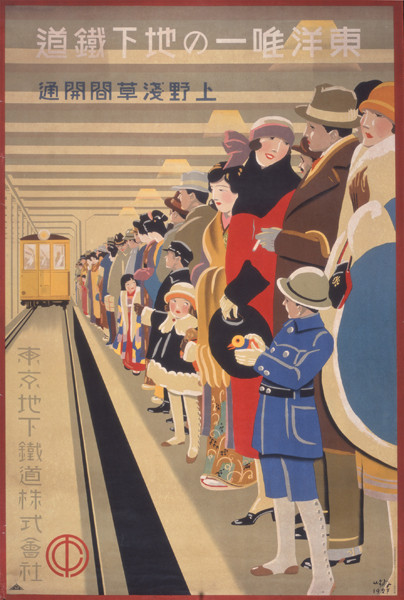
Taisho Imagerie was a style of visual imagery, primarily used in design and illustration, that blended traditional Japanese aesthetics with early twentieth-century Western influences such as Art Nouveau ( characterized by flowing, organic lines inspired by nature, especially plants and flowers) and Art Deco, known for bold geometric shapes, rich colors, and luxurious materials. The term imagerie comes from the French word for “imagery” or “picture.” This style flourished in Japan during the Taisho period (1912–1926), a time of rapid modernization.
Japan’s contact and cultural exchange with the West, combined with a comparatively liberal social climate, gave rise to a visually diverse and richly layered artistic culture. With the spread of printing technology and the rise of mass media, these designs could be widely reproduced in book illustrations, magazine covers, posters, and advertisements, making them accessible to the general public. Taisho Imagerie left a lasting mark on Japan’s aesthetic sensibilities, influencing both popular and fine art.
When I visited the museum, I found myself constantly in awe. The precision of the details, the arrangement and harmony of elements, and the way different influences were woven together created an aesthetic experience that felt smooth, orderly, and deeply satisfying.
One of the most memorable concepts I encountered was élan vital, a philosophical idea introduced by Henri Bergson. This term refers to a vital impulse or life force that drives evolution and creativity. Bergson presented the idea in his 1907 book Creative Evolution, offering an alternative to purely mechanistic explanations of evolution, including Darwinism, which was highly influential at the time. Instead of viewing life as determined entirely by fixed natural laws, Bergson proposed that it is shaped by an unpredictable, creative force, an idea that resonated strongly with many artists and intellectuals of the Taisho era.
Crash Course on Taisho Imagerie
大正時代は、雑誌を中心としたグラフの流行で、印刷技法の革新の時代だと言えます。
The Taisho era can be called an era of innovation in printing methods, marked by the popularity of magazines and graphic publications.
明治時代のはじめは、和綴、片面木版摺、袋綴による印刷で両面印刷、現在の書籍のごときものはできませんでした。
At the beginning of the Meiji period, printing was done with Japanese binding, single-sided woodblock printing, and pouch binding, so double-sided printing like modern books was not possible.
鉛活字の中綴り、同じ高さにそろえたレッスするの本ができるのはヨーロッパの書籍を模した堅装本の印刷文化を引きずっていたからです。
That they were able to produce stitched books with lead movable type, aligning to the same height, was because they inherited the printing culture of sturdy, hardbound books modeled after those of Europe.
そのころに続いた江戸時代の木版印刷の刷方方法は明治末頃まで続きました。
The woodblock printing techniques that continued from the Edo period lasted until around the end of the Meiji era.
さて、冊絵代わり木の板は、「コマ絵板」と呼ばれて、新聞や雑誌で使われた後、廃棄されるものでしたが、地方の新聞などで再利用されたものもあったようです。
Now, the wooden plates used for illustrations, called “koma-e boards,” were discarded after being used in newspapers and magazines, but it seems that some were reused in local newspapers.
目をつけたのが小杉未醒(放菴)で自分が版元に渡した原画から彫り上げ、印刷した後、廃棄されるはずの木版を引き受け、これを冊子にしたのが「コマ絵集」でした。
It was Kosugi Misei (Hosai) who paid attention to this: he took over the woodblocks that were supposed to be discarded after being engraved and printed from the original pictures he had submitted to the publisher, and made them into booklets called “Koma-e Collections.”
末醒に「詩興画趣詩」として名をあげた竹久夢二をコマ絵作家として一躍スターダムに押し上げた「コマ絵集『春巻』」は、やはり廃棄されるはずの木版で印刷されています。
“Koma-e Collection: Harumaki,” which quickly launched Takehisa Yumeji (who had already gained fame with “Poems and Humor Pictures”) into stardom as a koma-e artist, was also printed using woodblocks that were supposed to be discarded.
そんな木版コマ絵の時代と並行してあったのが、やはり印刷技です。
And what existed alongside this era of woodblock koma-e were, as expected, printing techniques.
錦絵から続いていた多色木版による挿絵で、本の絵や挿絵に使われていた多色木版印刷は、明治末から続いた時代で、やがて石版印刷、絵師が原画を描き、摺師、彫師に当たればでき上がるのは希だったようです。
The multi-color woodblock prints used for book illustrations and pictures, which continued from nishiki-e, lasted until the late Meiji period, but it seems that it became rare for an artist to draw the original, and then both the printer and carver to realize the artwork.
それよりも、絵師が気に入った場合は、自分で彫る、摺るの一人二役の現代絵本作家が起こり、明治末には移っていきます。
More than that, in cases where the artist liked the work, modern picture book creators came to appear who would carve and print themselves, playing a dual role. This transition occurred by the late Meiji period.
摺師が必ずしも絵師の一門に入る芸術家腕のいる職人とは、傍友社の紅葉などとの職人は、倩友の抱堂など、現在とは違って、とても親しみ渡辺省亭の口絵の一部には、多色摺木版に代わって多色石版代わりに出てきます。
Unlike today, where the printer does not necessarily belong to the same school as the artist, artisan-printers like Beniyuusha’s Momiji or Syouyu’s Houdou were close companions. Some of Shotei Watanabe’s frontispiece prints, for example, shifted from multi-color woodblock to multi-color lithography.
多色石版印刷は、大量に量産ができます。
Multi-color lithographic printing allows for mass production.
明治末から大正という時代、出版のス・メディア化の時代に対応した印刷方法でした。
It was a printing method that responded to the era of print and media around the end of the Meiji period and into the Taisho period.
木版が日本の伝統印刷法だとしても、銅活字ともにヨーロッパからもたらされ、石版は、銅活字とともに木版から石版へという移行がわかります。
Even though woodblock printing was Japan’s traditional method, together with lead type brought from Europe, it can be seen that there was a transition from woodblock printing to lithography, along with the adoption of movable type printing.
もっとも、この木版から石版への移行は、けっしてスムーズに行われたわけではありません。
However, this transition from woodblock to lithography was by no means smooth.
出版社でも、雑誌や絵葉書などで大量印刷を行いはじめ、大量印刷で名高い博文館は、印刷会社と提携、早々と石版による大量生産へと移行しましたが、夏目漱石などの出版で名高い春陽堂は、大正に入っても木版にこだわり、泉鏡花 小村雪岱本などを美しい本を今の時代に残してくれています。
Some publishers began large-scale printing with magazines and postcards. Hakubunkan, renowned for its mass printing, partnered with printing companies and quickly switched to mass production using lithography. However, Shunyodo, known for publishing authors like Natsume Soseki, remained committed to woodblock printing even after entering the Taisho era, leaving us with beautiful books such as Izumi Kyoka and Komura Settai’s works.
その石版印刷、重い石版石を使ったものから、簡単なジンク(亜鉛)版を用いたものに代わってゆきます。
Lithographic printing also shifted from using heavy lithographic stone to using simpler zinc (zinc alloy) plates.
さらに、そがら四原色の組み合わせでカラー印刷の質を上げたオフセット印刷へ、そして、写真製版の再現性に優れたオフセット印刷へと進化してゆきます。
Furthermore, with the combination of four primary colors, offset printing improved the quality of color printing, and then evolved into offset printing capable of highly faithful photo reproduction.
このように見ていくと、大正という時代は、まさに印刷革新の時代であったと言えましょう。
Looking at it this way, the Taisho era can truly be called an age of innovation in printing.
19世紀のフランスでは市民革命のかで出版文化が興隆しました。上流層まで出版文化や美術の複製版画などが広く、教育、向けの書物や美術の複製版画、民衆版画が政治情報や説話、商品広告などで展開しました。
In 19th-century France, under the influence of the civil revolution, publishing culture flourished. Publishing culture and reproduced artworks such as prints spread widely even to the upper classes, with books and reproductions of artworks being used for education, and popular prints being utilized for political information, storytelling, and product advertisements.
イギリスでは子ども向けの絵本が発達し、美しい挿絵とともに、中世の騎士物語や妖精物語化された動植物などのロマン主義的な物語が各国に影響を与えました。
In England, picture books for children developed, and with beautiful illustrations, romantic tales such as medieval knight stories and fairy tales featuring animals and plants came to influence many countries.
世紀末には国際的な都市文化が花開き、新聞雑誌から、家具調度品、建築に至るまでの生活全般に、新しい感性と素材にふさわしい様式が生み出されました。
By the end of the century, international urban culture flourished, and across all aspects of life—from newspapers and magazines to furniture, furnishings, and architecture—new sensibilities and styles suited to new materials were created.
一方で、法律家や実業家らが新興中流層の合理主義や功利主義への反動がおこります。
On the other hand, among lawyers and entrepreneurs, there arose a backlash against the rationalism and utilitarianism of the new middle class.
そして、個人の感情や欲望、宗教的な感性を、使い古された芸術の形式によらずに表わそうとする芸術が広がりました。
Consequently, art that aimed to express individual emotions, desires, and religious sensibilities, without relying on conventional artistic forms, began to spread.
これらの思潮は、アール・ヌーヴォー、世紀末芸術、ボなどのデザイン運動々、広がります。
These trends spread to design movements such as Art Nouveau, Fin-de-Siècle art, and beyond.
スト印象派、象徴派、分離派などさまざまに名づけられているとともに、芸術家の個性と感受性にもとづく創造に、新しい芸術を生み出したい、という理想の根底にあります。
Movements such as the Impressionists, Symbolists, and Secessionists, among many others, were so named, and at their core lay the ideal of wanting to create new art based on the individual personalities and sensitivities of artists.
芸術家を刷新したい、という理想の根底にあります。
It is this aspiration to renew the role of the artist that underpinned these ideals.
その根底において結びついた表現には、時代にふさわしい表現に価値をおく考え方――モダニズムもありました。
In the foundational thinking behind these forms of expression, there was also the idea of valuing modes of expression appropriate to the times, what is known as Modernism.
それは芸術と社会に革新を起こそうと先鋭化する前衛(アヴァンギャルド)へと先鋭化し、20世紀初頭の実現主義や未来派、ダダイスム、構成主義、シュルレアリスム、バウハウスなどの運動を生み出しました。
This radical drive to innovate in art and society sharpened into avant-garde movements, leading to the birth of early twentieth-century movements such as Constructivism, Futurism, Dadaism, Surrealism, and Bauhaus.
アール・ヌーヴォーはまた、工芸や建築、文学、美術、音楽などのジャンルを融合し、新しい芸術を生み出そうとする運動でもありました。
Art Nouveau was also a movement seeking to create new art by fusing genres such as crafts, architecture, literature, fine arts, and music.
芸術家は絵画彫刻だけでなく、舞台美術や衣装、家具調度品、陶芸、テキスタイルのデザインを手がけ、写真や映像などの新しいメディアに取りくみました。
Artists did not work only in painting and sculpture, but also in stage design, costumes, furniture, ceramics, textile design, and actively engaged with new media such as photography and film.
なかでも、技術革新が進んだ出版は大きな役割を果たしたのです。
Among these innovations, publishing—which underwent significant technological advancement—played a major role.
街中の宣伝ポスターはミュシャやロートレックの手によって新しい芸術になりました。
Advertising posters in the city became a new art form through the work of Mucha and Toulouse-Lautrec.
雑誌や小冊子は、各国の最新の芸術を伝えるとともに、ピアズリーらが挑発的なイラストレーションを発表する場にもなりました。
Magazines and pamphlets conveyed the latest art trends from various countries, and served as places for artists like Aubrey Beardsley to present provocative illustrations.
一方で、人間の内面を掘り下げたデリケートな作品は、書斎で私的に鑑賞される挿絵入りの詩集や版画集として出版されました。
On the other hand, delicate works that explored the human inner world were published as illustrated poetry collections and print portfolios for private enjoyment in study rooms.
ゴーガンやムンク、カンディンスキーらは、あえて粗削りな木版画によって根源的な情動を表わしました。
Artists such as Gauguin, Munch, and Kandinsky deliberately used rough woodblock prints to express primal emotions.
1900年から1920年代の出版には、芸術界でも野心的な表現が含まれていたのです。
Publishing from 1900 through the 1920s included ambitious forms of expression even within the art world.
1920年代にはレコード、ラジオ、映画が大衆文化として台頭しました。
In the 1920s, records, radio, and cinema rose to prominence as elements of popular culture.
第一・次世界大戦(1914–18)の復興期ならではの享楽的な気分は、アメリカのジャズに象徴されます。
The sense of pleasure particular to the post–World War I recovery era (1914–18) is symbolized by American jazz.
また、1925年のパリ万博(通称・アールデコ万博)は各国からの訪問者に、パリの婦人服産業の豊かさと洗練を知らしめ、国際的な流行(ファッション)の発信地であることを印象づけました。
この後、音楽と映画、ファッションは巨大な文化産業になり、企業の宣伝広告とともに、グラフィックデザイナーとイラストレーターが活躍する場を広げていきました。
Additionally, the 1925 Paris Exposition (commonly called the Art Deco Expo) provided visitors from around the world with the latest information about Parisian women’s fashion and decorative design.
It showcased the richness and sophistication of the industry, establishing an impression of Paris as an international center for trends (fashion).
After this, music, film, and fashion became enormous cultural industries. Alongside companies’ advertising and publicity, graphic designers and illustrators found ever-widening opportunities to flourish.
In the mid-Meiji period, modern education replaced the systems of the Edo era and embraced a new national ethos in which students were expected to face life with seriousness. Academic dedication became a point of honor. Schools urged, and sometimes compelled, students to devote themselves entirely to study. Dreams and personal freedoms were curtailed by strict self-restraint and the repression that followed the movement for civil rights and freedom.
The energy that could not be expressed openly flowed into art, literature, and philosophy. European and Russian ideas of the inner life began to take root, echoed in Kitaro Nishida’s philosophy of pure experience and Natsume Soseki’s explorations of the self. Individuality, seen as the core of this inner life, resonated deeply with those who had known social and political suppression. Young intellectuals embraced the idea that the universe is alive with individual voices, each needing to be sensed and expressed.
This shift brought with it a fascination with romance and sexuality, ideals that grew stronger as the Meiji era advanced. European-style romantic love and medieval Christian notions of courtly love blended with Japanese sensibilities. The phrase “longing for romance” began to circulate widely. Its mood was captured in the covers of the literary magazine Myōjō, where Fujishima Takeji’s goddess-like women recalled the elegance of Mucha’s Art Nouveau style.
From 1896, Japanese artists began exploring the realism of Western-style photography. The visual arts still leaned on traditional ceramic and textile motifs until the 1900 Paris Exposition. Paintings, posters, and decorative works brought back by artists such as Kuroda Seiki sparked fascination. Mucha’s flowing, organic poster designs captivated the public and were quickly adapted by Japanese painters, designers, and illustrators. This moment also inspired a reevaluation of ukiyo-e through the lens of Art Nouveau. Intellectuals and students absorbed Western trends from imported magazines, among them Sōhō Tokutomi’s Kokumin no Tomo, which became a hub for such influences. Pharmacy student Sakurada Jitsugyo’s koma-e, or panel illustrations, appeared here with their rough, poetic, and humorous style. British picture books and European turn-of-the-century arts also shaped a wave of whimsical, imaginative drawings that could be fantastical or eccentric.
During the Taisho era, the French philosopher Lucien Lévy-Bruhl’s idea that life is created from within inspired a more expressive and individualistic publishing culture. Magazines showcased panel illustrations of women, children, and laborers in bold, expressive lines. This was the climate in which Yumeji Takehisa rose to prominence, his work appearing alongside avant-garde figures such as Yanase Masamu and Murayama Tomoyoshi.
In the late Taisho years, urbanization and capitalism brought commercial advertising to the forefront. At the 1925 Paris Expo, Art Deco design became the new visual language. Mass culture, driven by fashion, began to dominate public taste. In the early Showa period, graph magazines reporting on the latest in records, cinema, and style gained popularity. Graphic design emerged as a recognized profession, uniting photography, typography, and illustration to create atmosphere and mood. The poetic imagery of the Taisho period gave way to a sleeker, more commercial visual culture, closing one chapter in Japan’s modern artistic history while opening another.