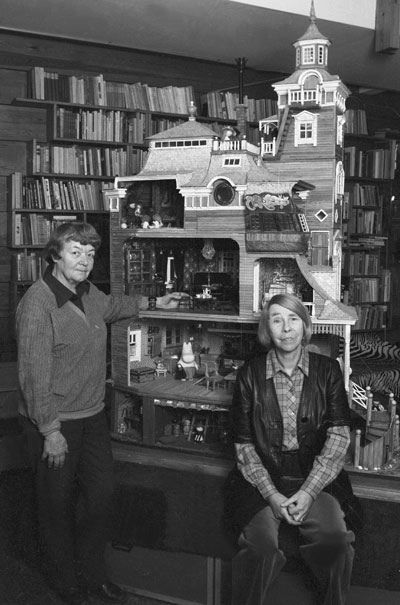
Tove Jansson was born in Finland in 1941. Her father was a sculptor and her mother a graphic designer. She lived through both World Wars, and even before facism swept through Finland, Tove was already a respected artist. When Finland partially allied with Nazi Germany, she began contributing to Garm, an anti-fascist magazine known for its sharp political satire and open criticism of both Hitler and Stalin. It was around this time she started writing fiction.
ちなみに, Tove liked Nietzsche and Bergson, but disliked Kant (perhaps a racist pseudoscientist, also, incidentally, from my knowledge, kinda anti-homosexual) and Schopenhauer.
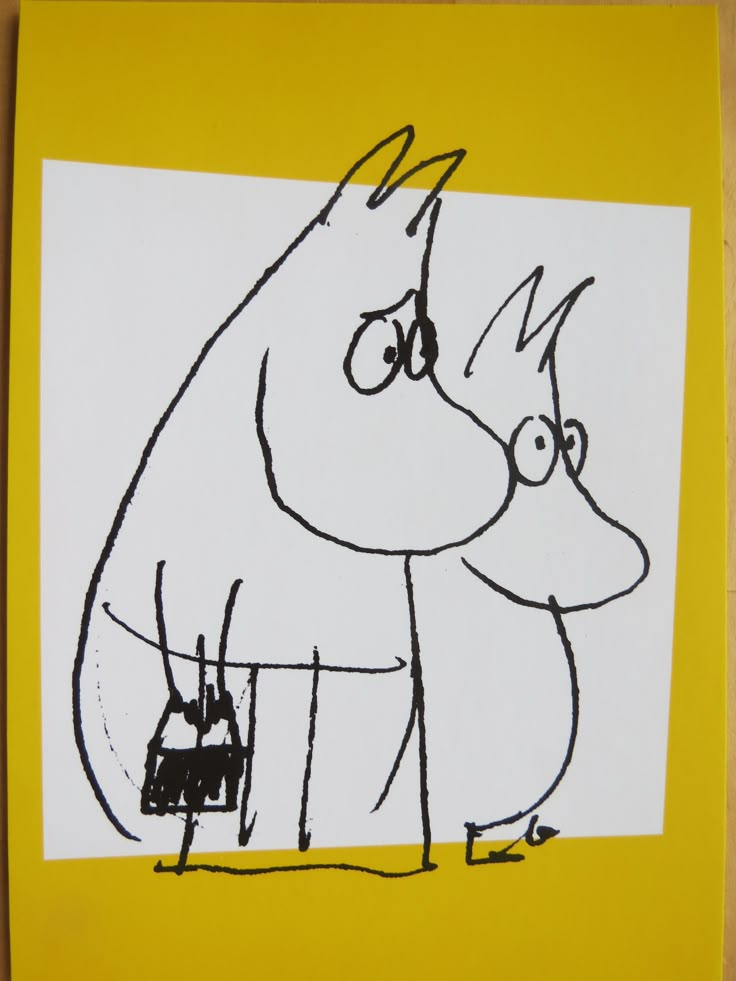
When she was five, after a fight with her brother, she drew an ugly long-nosed creature on the bathroom door and called it “Snork”. This became the prototype for the Moomin character. The name “Moomintroll” came from a story her uncle once told her, about a terrifying creature he called “Moomintroll”. The name stuck with her, and in a moment of inspiration, she used it in her first book, The Moomins and the Great Flood, published in 1945. Moominmama is warm and peaceful, while moominpapa is full of adventurous spirit.
In 1946, Tove published Comet in Moominland, a notable improvement from her previous work. The narrative pace became richer and more engaging. Just a week after she finished writing it, on August 6, 1945, the atomic bombing of Hiroshima occurred. Many readers saw the comet as a metaphor for the threat of nuclear weapons and war.
Though Moomin often comes across as naïve and childish, his open-mindedness and resilience remain central to the story.
One of the highlights of this book is Snufkin, a mysterious, aloof traveler and Moomin’s best friend. He despises authority, lives a care-free life and carries quiet wisdom. Just like Moominmama and Moominpapa were inspired by Tove’s parents in her real life, Snufkin’s character was based on someone close to her – Atos Wirtanen, a left-wing writer with whom she had a relationship, at one point even becoming engaged. Like Snufkin, Atos wore a big hat, smoked a pipe, and loved nature and travel. Eventually they broke up. In the story, Snufkin spends every summer in Moominvalley but always leaves when winter comes.
Tove also illustrated for many magazines, one of which was Swedish leftist magazine, Ny Tid (New Times). The children’s section needed a comic, and its editor happened to be Atos Wirtanen. Tove contributed to the comic strips, but it cut off after a year, as it drew a lot of criticism. However, the story later appeared in many adaptations, including TV shows, films, songs, and a 1949 theatrical production. The play, directed by Vivica Bandler, became famous. Vivica went on to direct the second play and a Moomin-related TV show. Around this time, Tove said she “went over to the spooky side”; she and Vivica began a romantic relationship. Vivica was married, and at the time, same-sex relationships were illegal in Finland. Their relationship remained discreet but deeply influenced the later Moomin stories.
In 1948, the Moomin family sets out to find a magical hat. Entered the new character: the Groke. Despite its large and frightening appearance, the Groke is actually lonely and longing for affection. Alongside Groke and the Hobgoblin, two more famous characters appear: Thingumy and Bob (English ver.), who wander through Moominvalley carrying a suitcase they stole from the Groke. Inside is the King’s Ruby, the very item the evil magician Hobgoblin is searching for. They turn to Moomin for help, and he not only drives away the Groke but also gives them a place where they feel safe and accepted.
Looking at the original Swedish text, though, it’s not hard to find that Thingumy and Bob are named Tofslan and Vifslan, which are the pet names Tove and Vivica used for each other. In the story, Tofslan and Vifslan care deeply for one another and guard the precious King’s Ruby, keeping it safe from the Groke, an embodiment of loneliness. In the end, they feel so accepted and welcomed in Moominvalley that they decided to share the ruby with everyone there. Moominvally is an very inlusive place. It embraces every traveler and makes them feel at home.
[Let us create more Moominvallyes in real life :)]
In 1950, Penguin Books published the English translation of Moominvalley, but before that, Jansson had gone through a period of uncertainty and financial instability.
In the newer story, the Moomin family meets the Mymble family (Mymble Mama and her many children). Two of the daughters appear frequently in the story: Mymble and Little My. Little My quickly became one of the most beloved characters. She’s chaotic, defiant of authority, yet also practical and helpful. The popularity of this book caught the attention of Charles Sutton, and Jansson signed a seven-year serialization deal with DMG media. After that, Moomin stories were translated into over 40 languages and reached more than two million readers.
During this time, two more books were published: Moominsummer Madness and Moominland Midwinter. In 1955, Tove invited a young Finnish woman named Tuulikki Pietila to dance. Tuulikki declined due to the propriety, but later sent Tove a greeting card with a cat drawing, inviting her to visit her studio anytime. From then on, they saw each other often and fell in love.
Tove was going through a difficult time. In order to meet the demands of large enterprises, she could no longer create many of the things she truly wanted to. At the same time, she also lost both of her parents.
Moominland Midwinter was quite different from the earlier stories. It portrays a lonely, quieter Moominvalley, and a more introspective Moomintroll, who wakes up unexpectedly from hibernation. He meets a new, spirited character: Too-ticky (probably based on Tove’s relationship with Tuulikki). In the story, Too-ticky is pragmatic, energetic, and comforting, helping Moomin navigate through the great uncertainty. As Too-ticky says, “Everything is very uncertain, and that is what makes me calm.”
Tove’s next book was a short picture book called Who Will Comfort Toffle? It tells the story of a shy, timid boy named Toffle who falls in love with an equally shy girl named Miffle, and slowly gain confidence. Originally, Toffle was supposed to be a girl, but due to censorship on queer characters by then, the character was changed to a boy.
In 1960, Tove’s brother Lars took over the Moomin comic strip and continued creating it for the next fifteen years.
——
I went to the Moomin art exhibition at Roppongi Hills with my friends yesterday. The audio guide was soothing and informative, offering insights into the artwork and the life of Tove Jansson. I wasn’t familiar with Moomin before and was brought by one of my friends, who’s a big fan of Moomin and Little My (her name happens to be the same as the translation of Little My).
I took away a lot from the exhibition. Standing still in front of the introductory panels about Tove Jansson’s life, pictures of where she painted, the works she created, I found myself reflecting on how she saw the world, especially after learning that she lived through two world wars. I resonate with the philosophy behind her work. I would say the exhibition told a compelling and thoughtful story, and it captured my attention. The souvenirs were beautifully designed as well. For the next few hours, I found myself fully immersed in the world of Moominvalley.
One downside, though, was that the exhibition seemed to gloss over some important context from Tove Jansson’s life and the emotional backdrop of her creative process – for instance, her romantic relationships with two women, or how the loss of her parents influenced her storytelling. That felt me a bit disappointed. Perhaps the organizers felt her personal relationships weren’t relevant to her art (which I do not agree, as ppl are living and creating in contexts), or maybe they preferred not to speculate to include details that might not resonate with a broader audience.